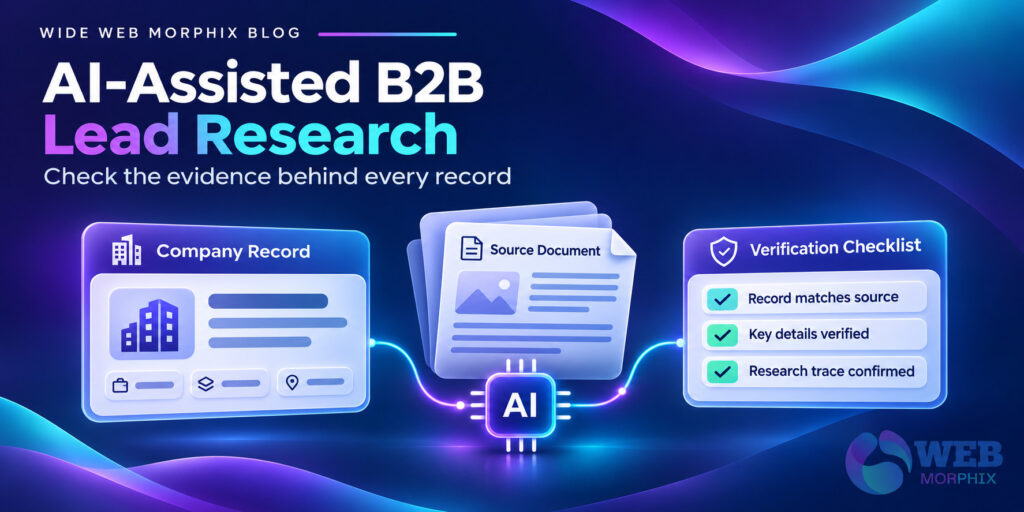
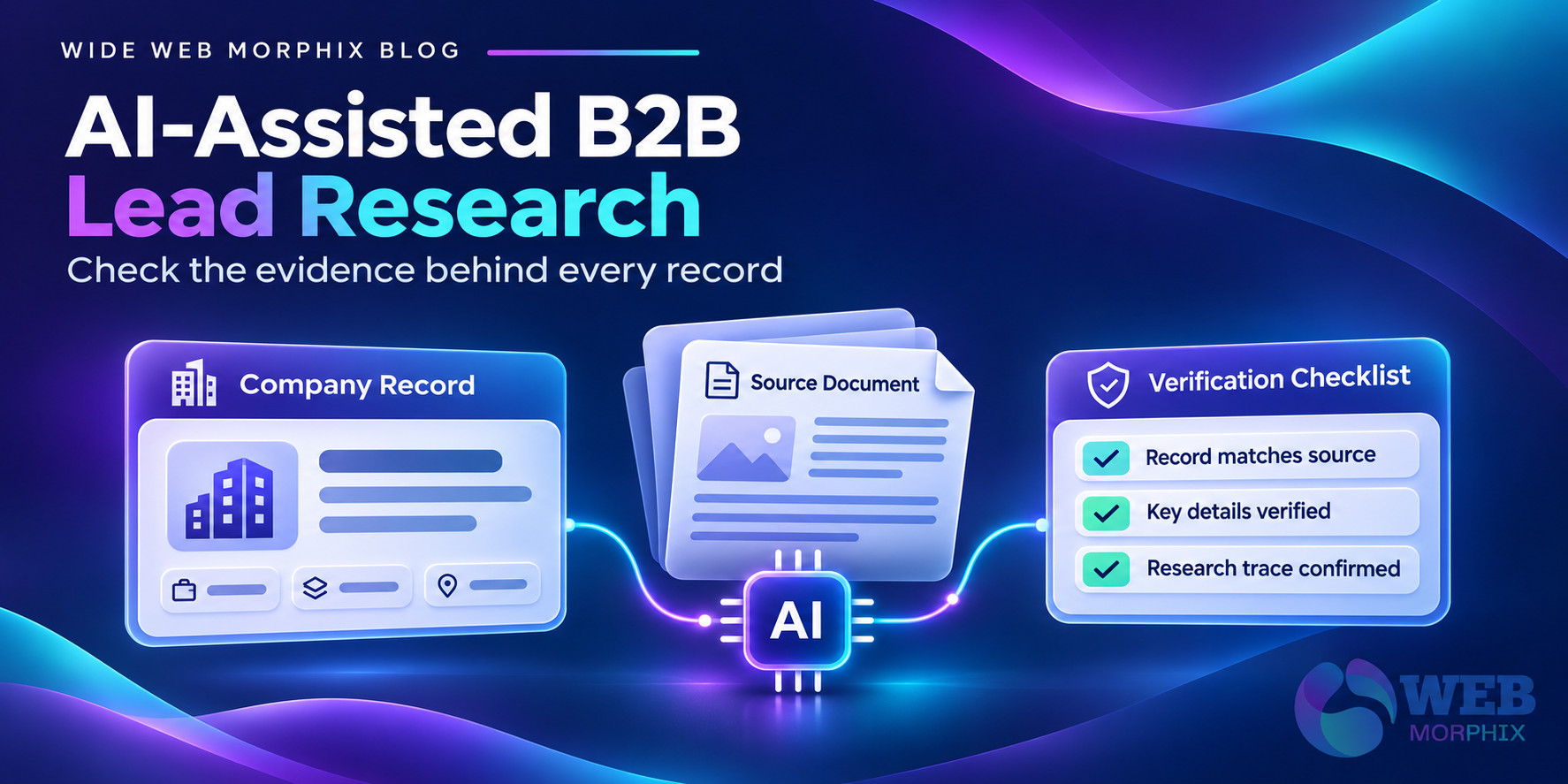
B2B lead research services should deliver records your startup can inspect, not just a large spreadsheet. Before hiring, agree the target companies, required fields, sources, verification dates and rules for uncertain information. AI can help organize findings and propose summaries; a person still needs to check the evidence and explain gaps.
A record can look complete while describing the wrong company or an outdated role. The buying decision is whether the research supports your actual sales process. Ask for a small, reviewable sample before committing to a larger batch, and evaluate relevance separately from contact availability.
What should B2B lead research services include?
Start with a written brief covering geography, business category, company characteristics and exclusions. Define the role or function you need to understand, rather than assuming every founder or generic inbox is a useful contact. Explain how your team intends to use the finished research.
| Quality area | Question for the provider | Evidence to request |
|---|---|---|
| Fit | Why does this company match the brief? | Relevant observed facts and source links |
| Accuracy | Which source supports each important claim? | A traceable source and clear uncertainty label |
| Completeness | Which fields are required? | Missing values shown without guessing |
| Freshness | When was the information checked? | A verification date for time-sensitive details |
| Uniqueness | How are duplicate companies handled? | Matching rules and treatment of branches |
Salesforce’s data quality overview identifies accuracy, consistency, completeness and reliability as relevant standards. Apply those ideas to the records you are buying, rather than relying on a provider’s single quality label.
Separate company fit from buying intent
A company can match your audience without currently looking for your service. A public social post, an active store or a recent website change can provide context. None of those observations proves a budget, a hiring decision or a willingness to buy.
Ask the provider to distinguish observed facts from interpretation. For example, a hypothetical record might say that a company’s website lists several locations and link to the locations page. A suggestion that the business needs operations support should remain a research hypothesis, not be presented as a verified requirement.
This distinction helps startup teams prioritize thoughtfully. It also prevents a list from creating false confidence simply because each row contains a persuasive AI-generated summary.
Define what “verified” means before paying
Ask how each field is checked. A company website, a role listing and a contact-checking tool answer different questions. A technically valid contact detail does not establish that the person is relevant, expects your message or has purchasing authority.
Request definitions for statuses such as checked, unavailable, uncertain and excluded. Agree how the provider handles conflicting sources and which fields require a fresh check. If a source is inaccessible, the record should say so instead of implying it was reviewed.
Keep the research scope separate from outreach approval. Receiving a spreadsheet does not authorize a provider to contact anyone for you. Your team should decide the intended use and review the audience before any sending activity.
Where AI-assisted lead research helps
AI can help organize approved public information, suggest categories or prepare a short account brief. The reviewer should compare important claims with the cited source and remove unsupported conclusions. A plausible company description is not a substitute for evidence.
For an illustrative Shopify research project, you might ask for merchants in an agreed market with a particular product category. The researcher would verify the category and company identity, record the source, and flag uncertainty about the platform or buyer role. AI could prepare the summary after those facts are available.
Do not ask the researcher to fill every blank at any cost. A visible missing field is more useful than an invented name, revenue estimate or technology claim that later misdirects your team.
Review a sample against acceptance criteria
Agree the sample format before production. Include the company name, canonical website, relevant source links, observed fit, last-check date, requested contact fields and open questions. The sample should resemble the final deliverable rather than a specially polished presentation with different fields.
- Check identity: confirm the record refers to the intended company and location.
- Inspect fit: compare observed facts with the brief and exclusions.
- Open sources: verify important claims are supported by accessible evidence.
- Review gaps: check how missing or contradictory information is labeled.
- Test handoff: confirm the file can be used in your existing tracker or CRM.
Record why you accept or reject a sample row. Feed those decisions back into the brief before scaling. This is a practical acceptance process, not a guarantee that research will produce clients.
Ask about duplicate rules and CRM handover
Decide whether a parent company, branch and separate brand should be one account or distinct records for your purpose. Ask the provider to check against the reference list you supply, where that comparison is part of the scope.
If existing CRM records need correction first, review what to check before hiring CRM cleanup services. Research, cleanup and importing records may be separate deliverables. Confirm each one rather than assuming a spreadsheet quote includes changes inside your live systems.
Ask for consistent field names, source and date columns, clear status labels and a short explanation of the method. A usable handover should make it possible for another person to understand why a record was included.
How to compare prospect research services
Give prospective providers the same brief and sample requirements. Separate research depth, required contact fields, verification effort and delivery format. A basic company list and a source-backed buyer brief involve different work.
Clarify correction terms, review timing and what happens when a required field cannot be found. Avoid choosing solely on record count. More rows do not compensate for a mismatch with the market or an absence of evidence.
Frequently asked questions
Can B2B lead research services guarantee clients?
No. Research supports selection and preparation. Sales outcomes also depend on your offer, timing, relevance and how your team handles conversations.
Should every record have a named contact?
Only if that is required by the brief and supported by available evidence. Agree how unavailable contacts are reported and whether company-only research is still useful.
How fresh should the research be?
Choose a review window based on the fields you need and when you will use them. Require visible check dates for time-sensitive facts rather than an undefined “fresh data” promise.
Is AI-generated research ready to import?
Not automatically. Check sources, field consistency, duplicates and the intended import rules first. Keep uncertain values visible and obtain approval before changing live records.
Start with a research brief your team can assess
Bring your target market, exclusions and an example of a useful account when you request a scoped lead research conversation with Web Morphix. Ask for the fields, evidence, review process and handover to be agreed before production. Start with a sample you can check, then expand based on the quality of the work.