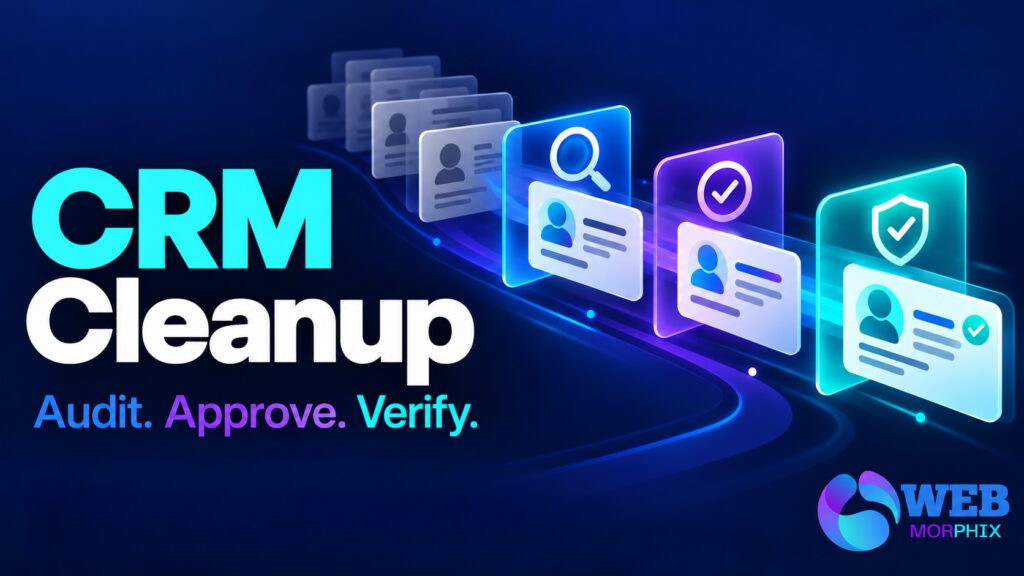
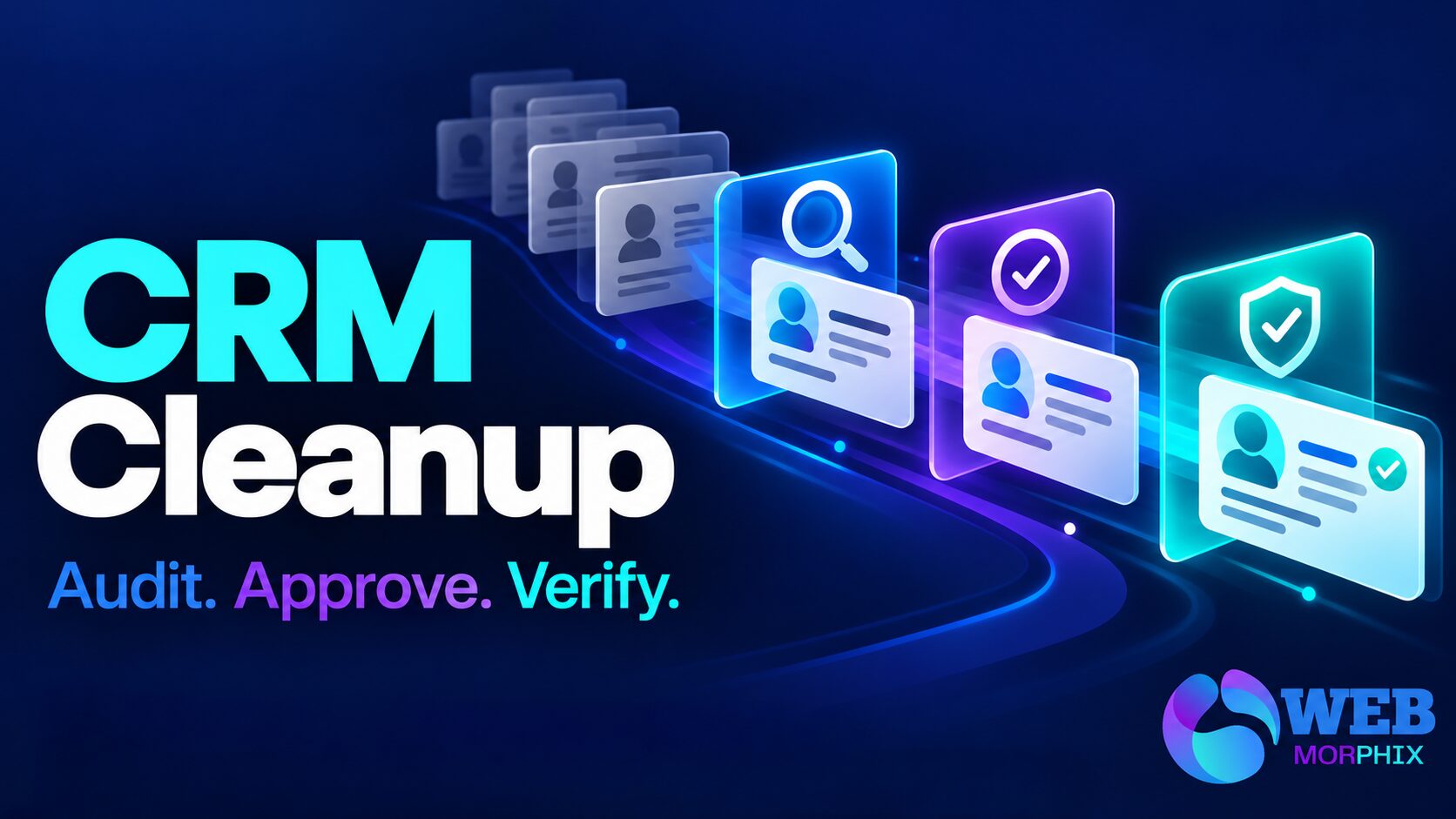
CRM cleanup services should leave your startup with clearer records, documented decisions and a usable handover. Before hiring a provider, ask for an audit, written matching rules, approval boundaries and a sample of the final change report. AI can help flag inconsistencies and prepare suggestions; a responsible person still needs to verify uncertain matches and approve consequential changes.
A lower contact count is not proof of a better database. Two people at the same company may be separate buyers. An old record may contain useful sales history. The buying decision is whether a provider can explain what should change, why it should change and how you will check the result.
What should CRM cleanup services include?
A useful scope separates discovery, proposed changes, approved execution and verification. Ask which objects are covered: contacts, companies, deals and activities can require different rules. Confirm whether the project includes only data correction or also changes to pipelines, integrations and automations.
| Work area | Deliverable to request | Decision you retain |
|---|---|---|
| Duplicate contact cleanup | Candidate pairs with record IDs and matching reasons | Which evidence permits a merge |
| Field consistency | Field map and approved value list | Which business definitions apply |
| Ownership gaps | Unassigned records and proposed routing | Who owns each relationship |
| Missing information | Verified updates with sources, plus unresolved gaps | Which sources and fields are acceptable |
| Workflow impact | Relevant dependency checks and test results | Which live workflow changes are authorized |
For example, standardizing a company-name field may be straightforward, while changing a lifecycle stage could affect a report or follow-up. A quote should distinguish these activities rather than group them under an unlimited promise to fix the CRM.
Ask for matching rules before approving merges
Ask the provider to explain both its matching rule and its rule for which values survive. A similar name is a clue, not conclusive identity evidence. Company domains, email addresses and record history can contribute to review, but the right combination depends on your CRM and how your team uses it.
Consider an illustrative pair: “Alex Lee” and “Alexander Lee” share a company domain but have different email addresses. One may be a renamed account, a second employee or a separate relationship. The appropriate result may be “needs review,” not an automatic merge.
Request a small, representative sample that includes obvious matches, ambiguous pairs and records that should remain separate. Ask the reviewer to explain each recommendation. Do not judge the pilot only by how many duplicates it claims to remove.
Platform behavior matters. HubSpot’s duplicate-management documentation describes review tools and subscription requirements. Its record-merging guidance states that merged records cannot be unmerged. Confirm the behavior of your own system before approving a batch; an export should not be described as a guaranteed one-click reversal.
Define the AI role and the human review
AI-assisted CRM data cleanup can support classification, normalization suggestions and explanations of possible matches. Ask what information the model receives and what happens when confidence is low. A provider should be able to show the reviewer the underlying evidence rather than ask you to trust a generated answer.
- Appropriate pilot: flag inconsistent job-title formats for review against an approved naming convention.
- Needs a business decision: choose which conflicting customer owner should remain.
- Needs verification: fill a missing company detail using a traceable source.
- Needs explicit authority: merge, delete, reassign or trigger communications.
Do not accept plausible-looking contact details as verified enrichment. Ask that unknown values remain unknown when evidence is missing. For startup CRM organization, a short exception list with clear next actions can be more useful than a fully populated database containing guesses.
Agree which AI tools may process the data and which fields can be shared with them. The practical question is specific: does this task require entire contact records, or can the provider work with a narrower set of approved fields?
Buy a scoped pilot with a checkable handover
Start with a bounded segment and an agreed cutoff date. A pilot lets you inspect the provider’s judgment before increasing the scope. Set acceptance criteria before work begins so that “finished” means more than a cleaned spreadsheet delivered without context.
- Record the baseline: which objects, fields, record IDs and known issues are included.
- Approve the rules: matching criteria, surviving values, excluded records and escalation cases.
- Review proposed changes: inspect a sample and resolve ambiguous business decisions.
- Authorize execution: specify who may change records and when.
- Verify and hand over: reconcile changes, inspect relevant associations and test affected workflows.
For an illustrative pilot, you might limit work to one imported contact list and two inconsistent fields. That is a scope example, not a recommended volume or a promise about turnaround. The provider should estimate effort after seeing the complexity, required reviews and available tools.
Request a handover containing the baseline, approved rules, changed-record log, unresolved exceptions and checks performed. Ask how the provider will account for edits made by your team during the project. Without a cutoff or reconciliation plan, an audit can become outdated while cleanup is still underway.
What should the quote spell out?
Compare providers against equivalent deliverables. Confirm whether fees include discovery, duplicate review, approved corrections, quality checks and documentation. Ask separately about enrichment tools, subscriptions, integrations and ongoing upkeep. A per-record price can be misleading if one quote includes difficult review work and another only flags obvious formatting issues.
For help covering both records and recurring workflows, review Web Morphix’s CRM and automation support. Discuss your actual platform and permissions before agreeing to a scope; a general service description does not establish compatibility with every tool.
Check why the database became messy
A one-time cleanup needs an owner for what happens next. Ask where inconsistent records enter the system: imports, forms, integrations, manual entry or unclear team conventions. Then separate the current cleanup from any prevention work you want quoted.
For example, correcting inconsistent lead-source labels will not stop a connected form from writing the old labels again. The handover should identify that dependency and name the next owner. Changing the form or integration is a separate action unless your scope expressly includes it.
A practical ongoing routine might include checking exceptions after imports, reviewing incomplete records and updating the field definitions when the sales process changes. Set a frequency that fits your workload. There is no universal cadence that makes a CRM accurate by itself.
Questions founders ask before hiring
Can AI clean a CRM without human review?
AI can assist with suggestions and repeatable checks. Someone still needs to own the rules, resolve uncertain identities and approve consequential changes. Define that responsibility before granting execution access.
Should I delete every stale contact?
No universal rule applies. Age alone does not tell you whether a record has business value or an applicable retention requirement. Define archive, retention and deletion decisions with the appropriate owner before the provider acts.
How do I know the project is complete?
Check the agreed scope against the change log, sample corrected records and inspect the exception list. Confirm that relevant associations and workflows were checked. A reduced contact count alone does not establish accuracy.
Do we need a new CRM instead of cleanup?
Start by distinguishing data-quality issues from missing system capabilities. A cleanup may help with inconsistent records; it will not supply features your system lacks. If a migration is needed, scope it separately, including field mapping and testing.
Bring a clear brief to your provider conversation
Prepare your CRM name, affected objects, approximate volume, recurring problems and the business decisions the data supports. Add your approval owner and any limits on access or AI processing. That gives a provider enough context to propose discovery and a manageable first phase without promising results before inspecting the system.
Request a scoped CRM cleanup assessment from Web Morphix. Explain the workflow that is getting stuck and ask for a clear audit, pilot and handover proposal.